A computer-assisted proof is a mathematical proof that has been at least partially generated by computer. Most computer-aided proofs to date have been implementations of large proofs-by-exhaustion of a mathematical theorem. The idea is to use a computer program to perform lengthy computations, and to provide a proof that the result of these computations implies the given theorem. In 1976, the four color theorem was the first major theorem to be verified using a computer program. Attempts have also been made in the area of artificial intelligence research to create smaller, explicit, new proofs of mathematical theorems from the bottom up using automated reasoning techniques such as heuristic search. Such automated theorem provers have proved a number of new results and found new proofs for known theorems. Additionally, interactive proof assistants allow mathematicians to develop human-readable proofs which are nonetheless formally verified for correctness. Since these proofs are generally human-surveyable (albeit with difficulty, as with the proof of the Robbins conjecture) they do not share the controversial implications of computer-aided proofs-by-exhaustion. == Methods == One method for using computers in mathematical proofs is by means of so-called validated numerics or rigorous numerics. This means computing numerically yet with mathematical rigour. One uses set-valued arithmetic and inclusion principle in order to ensure that the set-valued output of a numerical program encloses the solution of the original mathematical problem. This is done by controlling, enclosing and propagating round-off and truncation errors using for example interval arithmetic. More precisely, one reduces the computation to a sequence of elementary operations, say ( + , − , × , / ) {\displaystyle (+,-,\times ,/)} . In a computer, the result of each elementary operation is rounded off by the computer precision. However, one can construct an interval provided by upper and lower bounds on the result of an elementary operation. Then one proceeds by replacing numbers with intervals and performing elementary operations between such intervals of representable numbers. == Philosophical objections == Computer-assisted proofs are the subject of some controversy in the mathematical world, with Thomas Tymoczko first to articulate objections. Those who adhere to Tymoczko's arguments believe that lengthy computer-assisted proofs are not, in some sense, 'real' mathematical proofs because they involve so many logical steps that they are not practically verifiable by human beings, and that mathematicians are effectively being asked to replace logical deduction from assumed axioms with trust in an empirical computational process, which is potentially affected by errors in the computer program, as well as defects in the runtime environment and hardware. Other mathematicians believe that lengthy computer-assisted proofs should be regarded as calculations, rather than proofs: the proof algorithm itself should be proved valid, so that its use can then be regarded as a mere "verification". Arguments that computer-assisted proofs are subject to errors in their source programs, compilers, and hardware can be resolved by providing a formal proof of correctness for the computer program (an approach which was successfully applied to the four color theorem in 2005) as well as replicating the result using different programming languages, different compilers, and different computer hardware. Another possible way of verifying computer-aided proofs is to generate their reasoning steps in a machine readable form, and then use a proof checker program to demonstrate their correctness. Since validating a given proof is much easier than finding a proof, the checker program is simpler than the original assistant program, and it is correspondingly easier to gain confidence into its correctness. However, this approach of using a computer program to prove the output of another program correct does not appeal to computer proof skeptics, who see it as adding another layer of complexity without addressing the perceived need for human understanding. Another argument against computer-aided proofs is that they lack mathematical elegance—that they provide no insights or new and useful concepts. In fact, this is an argument that could be advanced against any lengthy proof by exhaustion. An additional philosophical issue raised by computer-aided proofs is whether they make mathematics into a quasi-empirical science, where the scientific method becomes more important than the application of pure reason in the area of abstract mathematical concepts. This directly relates to the argument within mathematics as to whether mathematics is based on ideas, or "merely" an exercise in formal symbol manipulation. It also raises the question whether, if according to the Platonist view, all possible mathematical objects in some sense "already exist", whether computer-aided mathematics is an observational science like astronomy, rather than an experimental one like physics or chemistry. This controversy within mathematics is occurring at the same time as questions are being asked in the physics community about whether twenty-first century theoretical physics is becoming too mathematical, and leaving behind its experimental roots. The emerging field of experimental mathematics is confronting this debate head-on by focusing on numerical experiments as its main tool for mathematical exploration. == Theorems proved with the help of computer programs == Inclusion in this list does not imply that a formal computer-checked proof exists, but rather, that a computer program has been involved in some way. See the main articles for details.
Digital omnivore
A digital omnivore is a person who uses multiple modalities (devices) to access the Internet and other media content in their daily life. As people increasingly own mobile devices, cross-platform multimedia consumption has continued to shape the digital landscape, both in terms of the type of media content they consume and how they consume it. As of 2021, at least half of all global digital traffic is generated by mobile devices. == Connected devices and digital consumption == A 2015 study of digital media consumption showed that smartphones were primarily used for communication, and tablets were primarily used for entertainment – additionally, both were frequently used in conjuncture with other devices, like televisions. An earlier 2011 analysis of the way consumers in the U.S. viewed news content on their devices throughout the day demonstrated how people use different mobile devices for different functions. On a typical weekend morning, digital omnivores accessed their news using their tablet, favored their computer during the working day, and returned to tablet use in the evening, peaking between the hours of 9pm and midnight. Mobile phones were used for web-browsing throughout the day when users were away from their personal computer. Increased Wi-Fi availability and mobile broadband adoption have changed the way people are going online. In August 2011, more than a third (37.2%) of U.S. digital traffic coming from mobile phones occurred via a Wi-Fi connection while tablets, which traditionally required a Wi-Fi connection to access the Internet, are increasingly driving traffic using mobile broadband access. As of 2021, LTE, 5G, and other forms of mobile broadband access are available on the majority of mobile devices. Tablets contributed nearly 2% of all web browsing traffic in the United States in 2011. During this period, iPads also began to account for a higher share of Internet traffic than iPhones (46.8% vs. 42.6% of all iOS device traffic. == Implications for marketing, advertisers and publishers == As of 2021, the average amount of time spent daily consuming digital media was eight hours, an increase from 2020 and a further increase from 2019, partially as a result of the COVID-19 pandemic. Social media platforms such as Instagram, Facebook, Twitter, and TikTok, as well as other online platforms like YouTube, incorporate advertisements into the in-app or online experience, with some offering the ability to shop for and sell items through the app or website.
Linux Trace Toolkit
The Linux Trace Toolkit (LTT) is a set of tools that is designed to log program execution details from a patched Linux kernel and then perform various analyses on them, using console-based and graphical tools. LTT has been mostly superseded by its successor LTTng (Linux Trace Toolkit Next Generation). LTT allows the user to see in-depth information about the processes that were running during the trace period, including when context switches occurred, how long the processes were blocked for, and how much time the processes spent executing vs. how much time the processes were blocked. The data is logged to a text file and various console-based and graphical (GTK+) tools are provided for interpreting that data. In order to do data collection, LTT requires a patched Linux kernel. The authors of LTT claim that the performance hit for a patched kernel compared to a regular kernel is minimal; Their testing has reportedly shown that this is less than 2.5% on a "normal use" system (measured using batches of kernel makes) and less than 5% on a file I/O intensive system (measured using batches of tar). == Usage == === Collecting trace data === Data collection is Started by: trace 15 foo This command will cause the LTT tracedaemon to do a trace that lasts for 15 seconds, writing trace data to foo.trace and process information from the /proc filesystem to foo.proc. The trace command is actually a script which runs the program tracedaemon with some common options. It is possible to run tracedaemon directly and in that case, the user can use a number of command-line options to control the data which is collected. For the complete list of options supported by tracedaemon, see the online manual page for tracedaemon. === Viewing the results === Viewing the results of a trace can be accomplished with: traceview foo This command will launch a graphical (GTK+) traceview tool that will read from foo.trace and foo.proc. This tool can show information in various interesting ways, including Event Graph, Process Analysis, and Raw Trace. The Event Graph is perhaps the most interesting view, showing the exact timing of events like page faults, interrupts, and context switches, in a simple graphical way. The traceview command is a wrapper for a program called tracevisualizer. For the complete list of options supported by tracevisualizer, see the online manual page for tracevisualizer.
Pocket (service)
Pocket, formerly known as Read It Later, was a social bookmarking service for storing, sharing and discovering web bookmarks, first released in 2007. Mozilla, the developer of Pocket, announced in May 2025 that it was discontinuing the service and would shut it down in July of that year. == History == Pocket was introduced in August 2007 as a Mozilla Firefox browser extension named Read It Later by Nathan (Nate) Weiner. Once his product was used by millions of people, he moved his office to Silicon Valley and four other people joined the Read It Later team. Weiner's intention was for the application to be like a TiVo directory for web content and to give users access to that content on any device. Read It Later obtained venture capital investments of US$2.5 million in 2011 and $5.0 million in 2012. The 2011 funding came from Foundation Capital, Baseline Ventures, Google Ventures, Founder Collective and unnamed angel investors. The company rejected an acquisition offer by Evernote after showing concerns that Evernote intended to shut down the Read It Later service and amalgamate its functionality into Evernote's main service. Initially, the Read It Later app was available in a free version and a paid version that included additional features. After the rebranding to Pocket, all paid features were made available in a free and advertisement-free app. In May 2014, a paid subscription service called Pocket Premium was introduced, adding server-side storage of articles and more powerful search tools. In June 2015, Pocket was included in Firefox, via a toolbar button and link to a user's Pocket list in the bookmark's menu. The integration was controversial, as users displayed concerns for the direct integration of a proprietary service into an open source application, and that it could not be completely disabled without editing advanced settings, unlike other third-party extensions. A Mozilla spokesperson stated that the feature was meant to leverage the service's popularity among Firefox users and clarified that all code related to the integration was open source. The spokesperson added that "[Mozilla had] gotten lots of positive feedback about the integration from users". On February 27, 2017, Pocket announced that it had been acquired by Mozilla Corporation, the commercial arm of Firefox's non-profit development group. Mozilla staff stated that Pocket would continue to operate as an independent subsidiary but that it would be leveraged as part of an ongoing "Context Graph" project. There were plans to open-source the server-side code of Pocket, though only parts of the project had been open-sourced as of 2024. On May 22, 2025, Mozilla announced that it would shut down Pocket on July 8, 2025. Exports of user data would be available until October 8, 2025, when accounts would be deleted. The email newsletter Pocket Hits was rebranded as Ten Tabs on June 12 as part of the closure, with it being changed to release only on weekdays. == Functions == The application allows the user to save an article or web page to remote servers for later reading. The article is sent to the user's Pocket list (synced to all of their devices) for offline reading. Pocket makes the article more readable by removing clutter and enabling the user to add tags and adjust text settings. == User base == The application had 17 million users and 1 billion saves, as of September 2015. Pocket was listed among Time magazine's 50 Best Android Applications for 2013. == Reception == Kent German of CNET said that "Read It Later is oh so incredibly useful for saving all the articles and news stories I find while commuting or waiting in line." Erez Zukerman of PC World said that supporting the developer is enough reason to buy what he deemed a "handy app". Bill Barol of Forbes said that although Read It Later works less well than Instapaper, "it makes my beloved Instapaper look and feel a little stodgy." In 2015, Pocket was awarded a Material Design Award for Adaptive Layout by Google for their Android application.
Closest point method
The closest point method (CPM) is an embedding method for solving partial differential equations on surfaces. The closest point method uses standard numerical approaches such as finite differences, finite element or spectral methods in order to solve the embedding partial differential equation (PDE) which is equal to the original PDE on the surface. The solution is computed in a band surrounding the surface in order to be computationally efficient. In order to extend the data off the surface, the closest point method uses a closest point representation. This representation extends function values to be constant along directions normal to the surface. == Definitions == Closest Point function: Given a surface S , c p ( x ) {\displaystyle {\mathcal {S}},cp(\mathbf {x} )} refers to a (possibly non-unique) point belonging to S {\displaystyle {\mathcal {S}}} , which is closest to x {\displaystyle \mathbf {x} } [SE]. Closest point extension: Let S {\displaystyle {\mathcal {S}}} , be a smooth surface in R d {\displaystyle \mathbb {R} ^{d}} . The closest point extension of a function u : S → R {\displaystyle u:{\mathcal {S}}\rightarrow \mathbb {R} } , to a neighborhood Ω {\displaystyle \Omega } of S {\displaystyle {\mathcal {S}}} , is the function v : Ω → R {\displaystyle v:\Omega \rightarrow \mathbb {R} } , defined by v ( x ) = u ( c p ( x ) ) {\displaystyle v(\mathbf {x} )=u(cp(\mathbf {x} ))} . == Closest point method == Initialization consists of these steps [EW]: If it is not already given, a closest point representation of the surface is constructed. A computational domain is chosen. Typically this is a band around the surface. Replace surface gradients by standard gradients in R 3 {\displaystyle \mathbb {R} ^{3}} . Solution is initialized by extending the initial surface data on to the computational domain using the closest point function. After initialization, alternate between the following two steps: Using the closest point function, extend the solution off the surface to the computational domain. Compute the solution to the embedding PDE on a Cartesian mesh in the computational domain for one time step. == Banding == The surface PDE is extended into R 3 {\displaystyle \mathbb {R} ^{3}} however it is only necessary to solve this new PDE near the surface. Hence, we solve the PDE in a band surrounding the surface for efficient computational purposes. Ω c x : ‖ x − c p ( x ) ‖ 2 ≤ λ {\displaystyle \Omega _{c}{x:\|x-cp(x)\|_{2}\leq \lambda }} where λ {\displaystyle \lambda } is the bandwidth. == Example: Heat equation on a circle == Using initial profile u S ( θ , t ) = sin ( θ ) {\displaystyle u_{S}(\theta ,t)=\sin(\theta )} leads to the solution u S ( θ , t ) = exp ( − t ) sin ( θ ) {\displaystyle u_{S}(\theta ,t)=\exp(-t)\sin(\theta )} for the heat equation. Forward Euler time-stepping is used with relation Δ t = 0.1 Δ x 2 {\displaystyle \Delta t=0.1\Delta x^{2}} and degree-four interpolation polynomials for the interpolations. Second-order centered differences are used for the spatial discretization. The CPM results in the expected second order error in the solution u {\displaystyle u} . == Applications == The closest point method can be applied to various PDEs on surfaces. Reaction–diffusion problems on point clouds [RD], eigenvalue problems [EV], and level set equations [LS] are a few examples.
Educational robotics
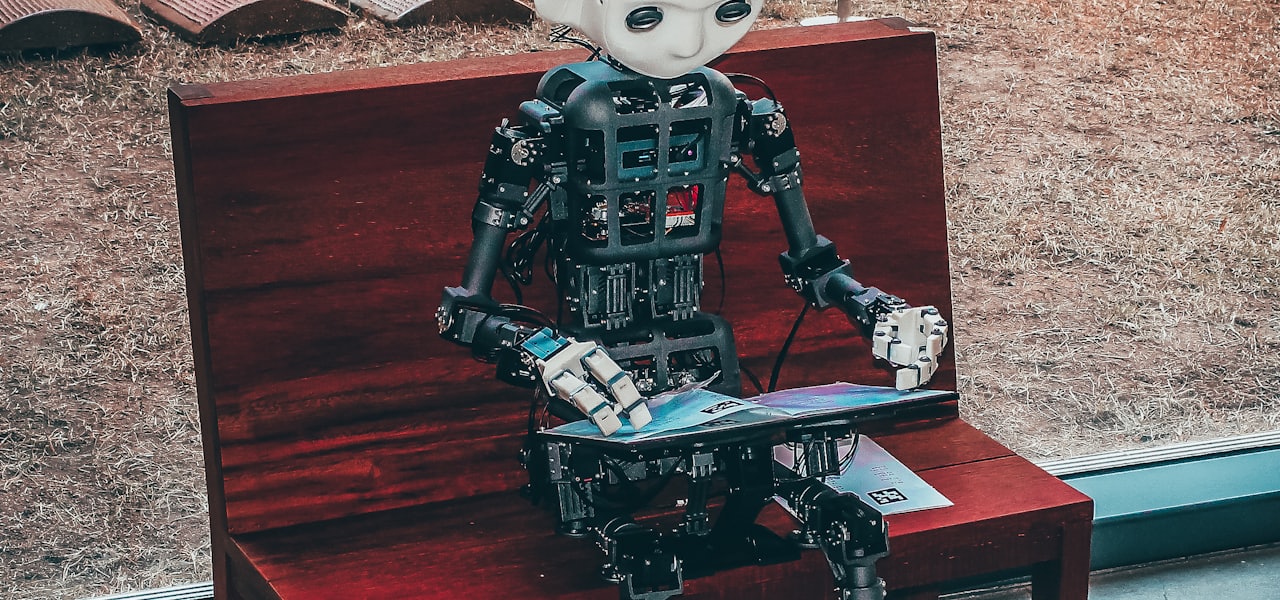
Educational robotics teaches the design, analysis, application and operation of robots. Robots include articulated robots, mobile robots or autonomous vehicles. Educational robotics can be taught from elementary school to graduate programs. Robotics may also be used to motivate and facilitate the instruction other, often foundational, topics such as computer programming, artificial intelligence or engineering design. == Education and training == Robotics engineers design robots, maintain them, develop new applications for them, and conduct research to expand the potential of robotics. Robots have become a popular educational tool in some middle and high schools, as well as in numerous youth summer camps, raising interest in programming, artificial intelligence and robotics among students. First-year computer science courses at several universities now include programming of a robot in addition to traditional software engineering-based coursework. == Category of Educational robotics == The categories of educational robots seen as having more than one category. It can be alienated into different categories based on their physical design and coding method. Generally they are categorised as arm robots, wheeled mobile robots and humanoid robots. Tangibly, coded robots uses a physical means of coding instead of the screens coding. === Initiatives in schools === Leachim, was a robot teacher programmed with the class curricular, as well as certain biographical information on the 40 students whom it was programmed to teach. Leachim could synthesize human speech using Diphone synthesis. It was invented by Michael J. Freeman in 1974 and was tested in a fourth grade classroom in the Bronx, New York. === Post-secondary degree programs === From approximately 1960 through 2005, robotics education at post-secondary institutions took place through elective courses, thesis experiences and design projects offered as part of degree programs in traditional academic disciplines, such as mechanical engineering, electrical engineering, industrial engineering or computer science. Since 2005, more universities have begun granting degrees in robotics as a discipline in its own right, often under the name "Robotic Engineering". Based on a 2015 web-based survey of robotics educators, the degree programs and their estimates annual graduates are listed alphabetically below. Note that only official degree programs where the word "robotics" appears on the transcript or diploma are listed here; whereas degree programs in traditional disciplines with course concentrations or thesis topics related to robotics are deliberately omitted. === Certification === The Robotics Certification Standards Alliance (RCSA) is an international robotics certification authority that confers various industry- and educational-related robotics certifications. === Summer robotics camp === Several summer camp programs include robotics as part of their core curriculum. In addition, youth summer robotics programs are frequently offered by celebrated museums such as the American Museum of Natural History and The Tech Museum of Innovation in Silicon Valley, CA, just to name a few. There are of benefits that come from attending robotics camps. It teaches students how to use teamwork, resilience and motivation, and decision-making. Students learn teamwork because most camps involve exciting activities requiring teamwork. Resilience and motivation is expected because by completing the challenging programs, students feel talented and accomplished after they complete the program. Also students are given unique situations making them make decisions to further their situation. === Educational robotics in special education === Educational robotics can be a useful tool in early and special education. According to a journal on new perspectives in science education, educational robotics can help to develop abilities that promote autonomy and assist their integration into society. Social and personal skills can also be developed through educational robotics. Using Lego Mindstorms NXT, schoolteachers were able to work with middle school aged children in order to develop programs and improve the children's social and personal skills. Additionally, problem solving skills and creativity were utilized through the creation of artwork and scenery to house the robots. Other studies show the benefits of educational robotics in special education as promoting superior cognitive functions, including executive functions. This can lead to an increased ability in "problem solving, reasoning and planning in typically developing preschool children." Through eight weeks of weekly forty-five-minute group sessions using the Bee-Bot, an increase in interest, attention, and interaction between both peers and adults was found in the school and preschool-aged children with Down Syndrome. This study suggests that educational robotics in the classroom can also lead to an improvement in visuo-spatial memory and mental planning. Furthermore, executive functions seemed to be possible in one child during this study.
Content as a service
Content as a service (CaaS) or managed content as a service (MCaaS) is a service-oriented model, where the service provider delivers the content on demand to the service consumer via web services that are licensed under subscription. The content is hosted by the service provider centrally in the cloud and offered to a number of consumers that need the content delivered into any applications or system, hence content can be demanded by the consumers as and when required. Content as a Service is a way to provide raw content (in other words, without the need for a specific human compatible representation, such as HTML) in a way that other systems can make use of it. Content as a Service is not meant for direct human consumption, but rather for other platforms to consume and make use of the content according to their particular needs. This happens usually on the cloud, with a centralized platform which can be globally accessible and provides a standard format for your content. With Content as a Service, you centralize your content into a single repository, where you can manage it, categorize it, make it available to others, search for it, or do whatever you wish with it. == Overview == The content delivered typically could be one or more of the following The technical terminology related to equipment or spares that is required to procure or design the materials The industrial terminology of the equipment or spares Technical values pertaining to various types, specifications, applications, characteristics of equipment or spares Sourcing information which will help in procurement or supply-chain management of equipment or spares Descriptive specifications of equipment or spares based on the product reference number or identifier UNSPSC codes or industry practiced classifications ISO, IEC compliant terminology Ontology or Technical Dictionary of products & services Predefined content for specific business needs The term "Content as a service" (CaaS) is considered to be part of the nomenclature of cloud computing service models & Service-oriented architecture along with Software as a service (SaaS), Infrastructure as a service (IaaS), and Platform as a service (PaaS).